Research

Research

My research follows language-model agents from electricity-carbon market simulation to strategic bidding and repeated pricing. Other projects ask what public outcomes reveal about hidden support, and what seasonal imagery adds to forest-type mapping.

Zero-Shot Strategic Bidding in Coupled Electricity-Carbon Markets

How can a generator adapt its bids to changing electricity and carbon prices without retraining its language model?

A generation company must account for the cost of producing electricity and its carbon obligations, then decide what markup to bid. Those are different reasoning tasks: the cost calculation sets the physical basis of a bid, while the markup depends on the market the generator faces.

Separate the calculation from the strategy

We organized an open-weight model around two reasoning layers, separating physical cost calculation from strategic markup. Rule-based verification sits between the layers. A sliding window of market feedback supplies the context for the next bidding round, allowing the agent to revisit its strategy as conditions change. There is no fine-tuning or parameter update: adaptation takes place through the information available at inference time.

Evidence from a simulated market

On the IEEE 14-bus system, the agent earned higher average profit than a fixed-markup baseline while clearing in every round. It also readjusted its bids under a sharp carbon-price shock. The comparison is specific to the simulated IEEE 14-bus setting and the fixed-markup baseline.
DWTS Voting Analysis: Hidden Support and Voting Rules

What can public scores and eliminations reveal when audience votes remain private?

I lead the current project, which extends our team’s MCM study. The broader analysis covers 34 seasons of Dancing with the Stars, combining Bayesian fan-support modeling with comparisons of rank and percentage aggregation, judge saves and fan saves.

What the observations leave unresolved

A separate identification analysis finds that many fan-share allocations can be compatible with the same observed exit. Its feasible regions depend on a declared deterministic voting rule; they are distinct from posterior credible intervals. Recovering a single plausible allocation therefore does not establish the actual vote totals.

A simpler predictor was hard to improve on

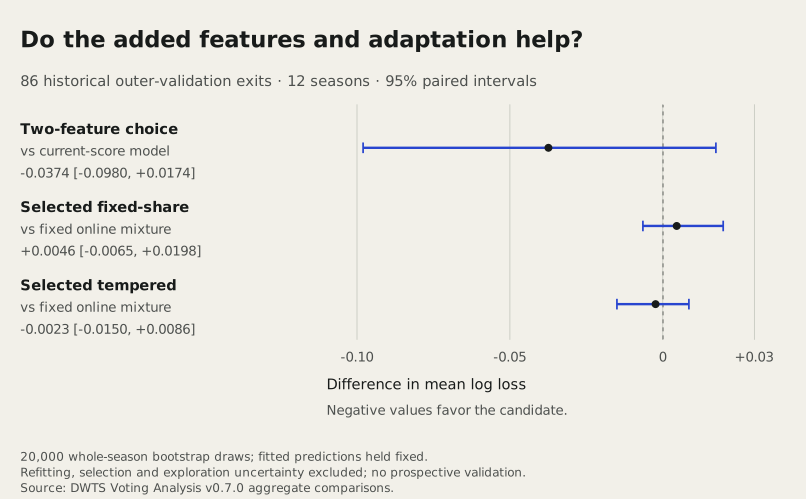
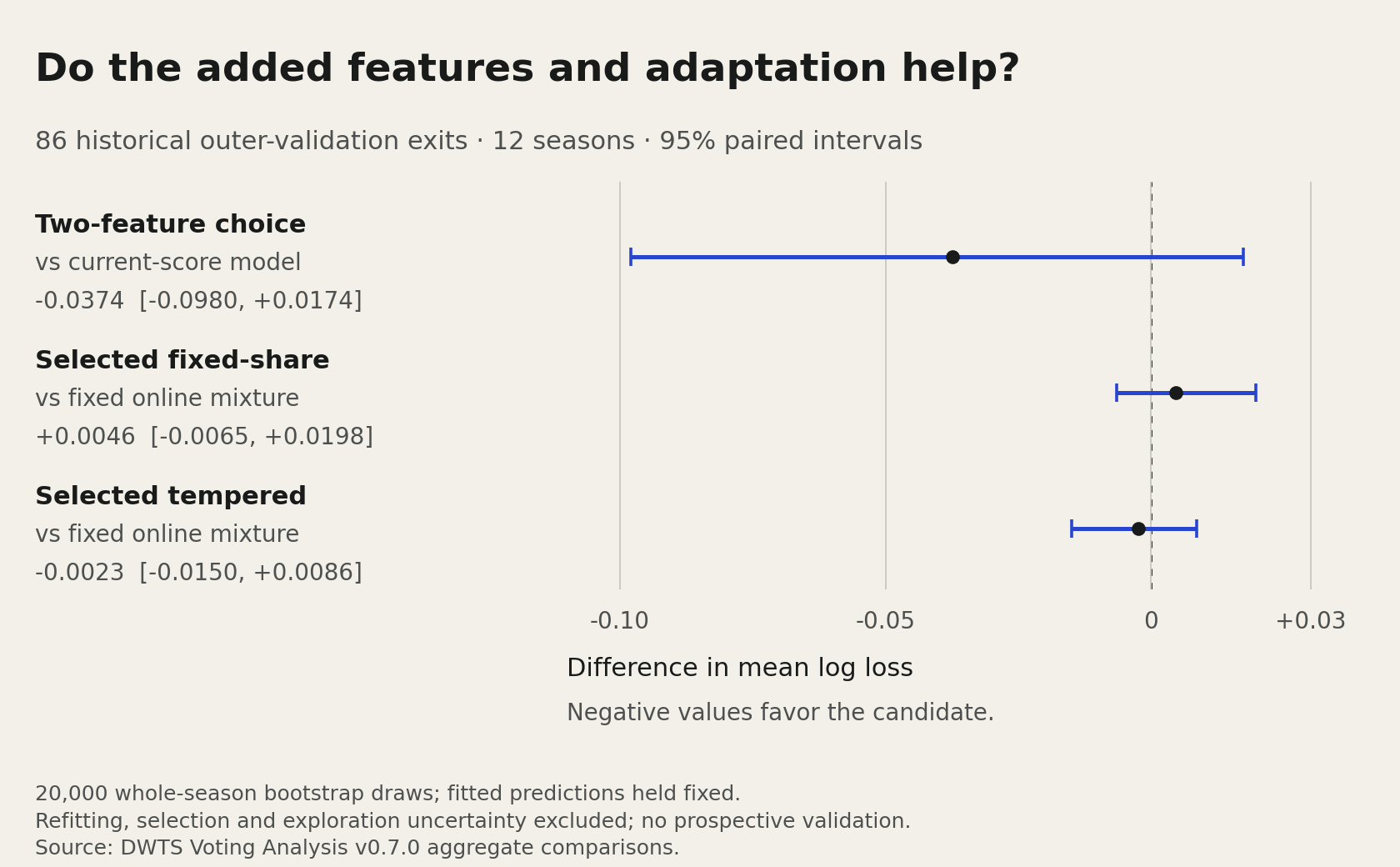
A separate forecasting study evaluates 86 eligible outer-validation eliminations across 12 seasons. It uses current judges’ scores and earlier score histories, selecting settings on earlier seasons and freezing probabilities before revealing each outcome. A two-feature predictor had the best outer-validation point log loss: 1.5040, versus 1.5414 for current scores alone. The paired season-bootstrap interval for that difference spans zero, so the apparent gain remains uncertain. Extra online adaptation did not consistently improve on the simpler fixed mixture.

Three paired log-loss differences, all with 95% intervals crossing zero: two-feature choice versus current scores, -0.0374 [-0.0980, +0.0174]; selected fixed-share versus fixed online mixture, +0.0046 [-0.0065, +0.0198]; selected tempered versus fixed online mixture, -0.0023 [-0.0150, +0.0086]. Negative values favor the candidate.

Selected historical outer-validation comparisons. Each dot is a candidate-minus-baseline difference in mean log loss; lines are 95% paired whole-season bootstrap intervals from 20,000 draws. All three intervals span zero.

Intervals condition on fitted predictions and exclude refitting, model-selection and repeated-exploration uncertainty.

Values and source
86 outer-validation eliminations across 12 seasons. Negative differences favor the candidate.
ComparisonChange95% interval
Two-feature choicevs current-score model-0.0374[-0.0980, +0.0174]
Selected fixed-sharevs fixed online mixture+0.0046[-0.0065, +0.0198]
Selected temperedvs fixed online mixture-0.0023[-0.0150, +0.0086]

Source aggregate table · Download plotted data (CSV)

The forecasting evidence is retrospective, on previously examined data, and does not validate hidden audience votes. Independent prospective validation remains outstanding. The linked provenance distinguishes our original team research from the AI-assisted post-report software and experiments.

LLM-CECM: Agent-Based Simulation of Coupled Electricity-Carbon Markets

I built the simulation pipeline for this study: data preprocessing, parallel agent rollout, market-state updates and visualisation. I ran the study on the IEEE 118-bus system, where generation companies act as language-model agents bidding into an electricity market coupled to a carbon market.

Two components address the cost of such a simulation and the quality of the decisions in it: adaptive decision frequency lets agents skip full reasoning when the market state has not moved, and counterfactual reasoning lets an agent evaluate bids it did not submit. In the reported comparison with full-frequency belief revision, adaptive decision frequency reduced model calls by 80.5% and runtime by 81.5%. In a separate congested-market experiment, the framework roughly halved a rolling price-volatility measure.

Strategic Adaptation of LLM Pricing Agents in Dynamic Markets

Two language-model sellers compete repeatedly in a simulated market, carrying private notes between rounds. A regulator can monitor prices, request a revision or impose a cap. The public release contains 15 stationary-market runs across these three oversight modes, with executed prices and selected agent text.

The dynamic experiment varies market size through two expansion-contraction cycles over 80 rounds, while holding static price benchmarks fixed. Agents see past prices, their own sales and profits, and their previous notes; the demand equation and future path are withheld. Five passive-monitoring runs are publicly available, with scripts that rebuild the figures without new model calls.

These records let us compare what agents write with the prices they execute. Matched stationary controls, memory interventions and deviation tests remain future work; the current runs do not establish what causes price persistence or whether it constitutes collusion.

Forest Type Mapping with Convolutions and Selective State Spaces

What do state-space blocks add to a model that combines seasonal imagery, terrain and climate?

I led a four-person project on nine-class forest-type segmentation from four seasonal Sentinel-2 composites, terrain and climate. The TensorFlow implementation combines convolutional encoders, custom Mamba-inspired selective state-space blocks and sample-dependent modality fusion. Training, checkpoint restoration, evaluation and tile prediction share the same pipeline.

A controlled small-cohort comparison

Six runs compare the state-space model with a CNN-only control across three paired seeds, using the same fixed ForTy cohort and ten-epoch budget. On 146 shared test tiles, mean macro F1 was 39.30% with the state-space blocks and 38.19% for CNN-only. Two seeds improved and one regressed. The state-space model also has 53.6% more parameters, so the small average difference does not isolate recurrence from model capacity. Full-benchmark evaluation remains pending.

Measure the implementation as well as the model

A separate Tesla T4 study measures batch scaling: batch eight delivered 4.80 times the inference compute throughput of batch one. It uses initialized weights and a repeated synthetic tile, excluding file IO and preprocessing. The repository keeps these runtime measurements separate from the real-data pilot.