From language-model markets to satellite imagery: the software, experiments and evaluation tools behind my work.
01
Project lead · Four-person deep-learning course project
CNN-Mamba Forest Type Segmentation
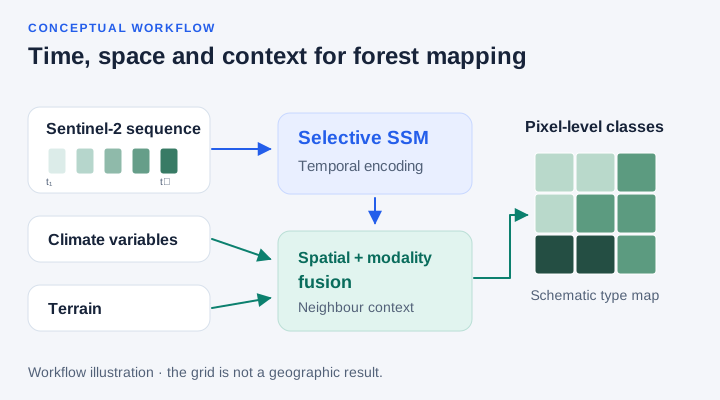
I led a project on nine-class forest-type mapping from four seasonal Sentinel-2 composites, terrain and climate. The TensorFlow pipeline combines convolutional encoders with custom Mamba-inspired selective state-space blocks, and supports controlled training, checkpoint restoration and tile prediction.
In a three-seed pilot on 146 shared ForTy test tiles, mean macro F1 was 39.30% with the state-space blocks and 38.19% for CNN-only. Two seeds improved and one regressed; the larger model has 53.6% more parameters. This is a small-cohort comparison, and full-benchmark evaluation remains pending.
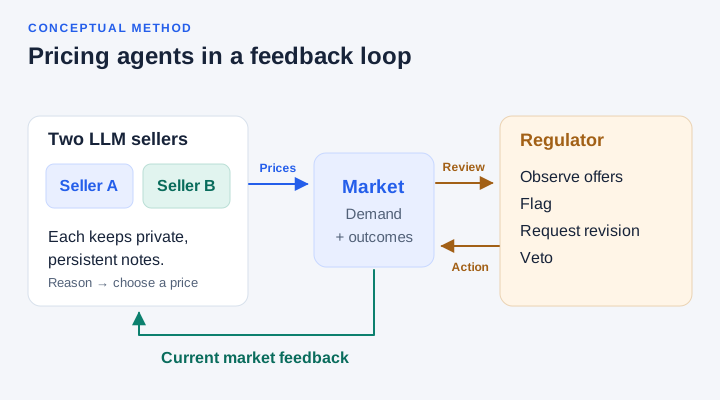
Two language-model sellers compete in a simulated pricing market, carry private notes between rounds, and face passive monitoring, revision requests or price caps. The public release contains 15 stationary-market runs and five 80-round passive demand-cycle runs, with price trajectories, selected agent text and scripts that rebuild the figures without new model calls.
The dynamic runs follow two expansion-contraction cycles while static price benchmarks stay fixed. Matched stationary controls, memory interventions and tests of collusive punishment remain future work.
Project lead · Original research with MCM Team 2627761
DWTS Voting Analysis
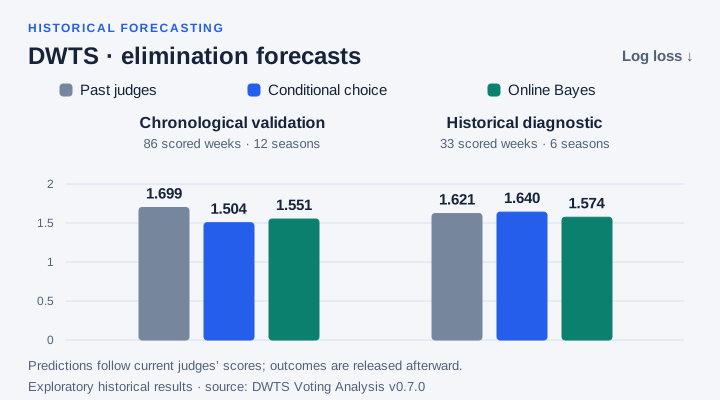
Python research software with separate workflows for latent fan-support inference, voting-rule comparisons and score-based elimination forecasting. Historical forecasts are recorded before each outcome is revealed to the model, settings are selected using earlier seasons, and expert weights update only after that reveal.
The published release includes experiment configurations, aggregate results, uncertainty analyses and runnable synthetic demonstrations. The forecasting study covers 86 outer-validation eliminations across 12 seasons; its historical comparisons do not validate the private audience votes.
Original capstone contributor · Current project lead
Long-Tail Driving Scene Discovery
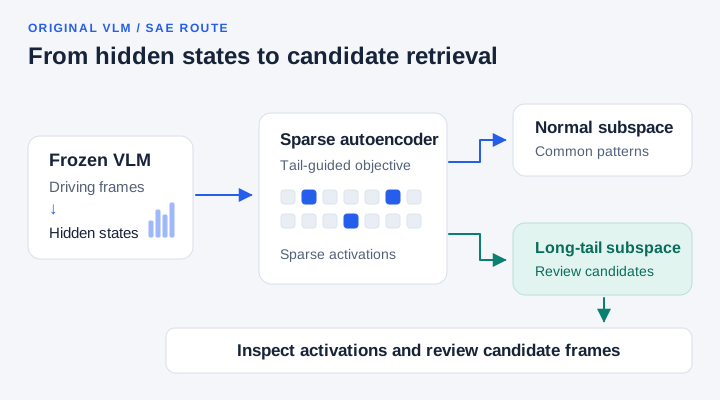
A six-camera scene-review workflow comparing sparse autoencoders with logistic regression and an MLP on shared frozen image features. I contributed SAE feature extraction and training to the original team capstone and now lead the CPU workflow, evaluation and review interface.
The completed CPU follow-up uses ResNet18 features, scene-disjoint splits, train-only normalization and validation-selected thresholds. A browser explorer connects saved scores to sparse activations and review queues. It is a separate feature protocol from the original vision-language-model route.
The fitted test set has 15 timestamps, and a frozen-policy replay covers nine later timestamps. Both reference sets came from one reviewer after exposure to model-generated labels, so broader generalization and the meanings assigned to individual features remain unvalidated.
Co-author · Official code companion to Renewable Energy paper
LLM-CECM Market Simulation
Fifty generator agents trade in coupled electricity and carbon markets on the IEEE 118-bus system. I built the study’s simulation pipeline, including preprocessing, parallel agent rollout, market-state updates and visualisation.
Adaptive decision frequency reserves language-model calls for consequential market changes. The reported simulation comparison uses 80.5% fewer model calls and 81.5% less runtime than full-frequency belief revision. The repository includes baselines, paper result tables and an offline end-to-end workflow with a mock model.
In this team course project for the Hull Tactical competition, I developed the LightGBM and XGBoost components of a return-prediction stack. The notebook combines tree models with Ridge regression and maps forecasts to portfolio exposure. The repository also documents the limitations of its historical evaluation.
An encoder-decoder Transformer for signed two-digit addition and subtraction. The PyTorch implementation builds attention, decoder masking and token-by-token prediction, with a notebook connecting training to generated answers.
Image captioning with a pretrained RegNet encoder and RNN, LSTM and attention-based decoders. The implementation includes recurrent forward and backward passes, scaled dot-product spatial attention and greedy caption generation.
 Open full-size diagram